Outer fabric
Decide fromAbrasion, water exposure, cleaning and desired appearance
Coated polyester/Oxford fabric is a common starting point.Buyer resource · RFQ guide
A useful quotation needs more than the outside dimensions of the instrument. Define the complete kit, field workflow, carrying load and approval criteria before requesting a sample.
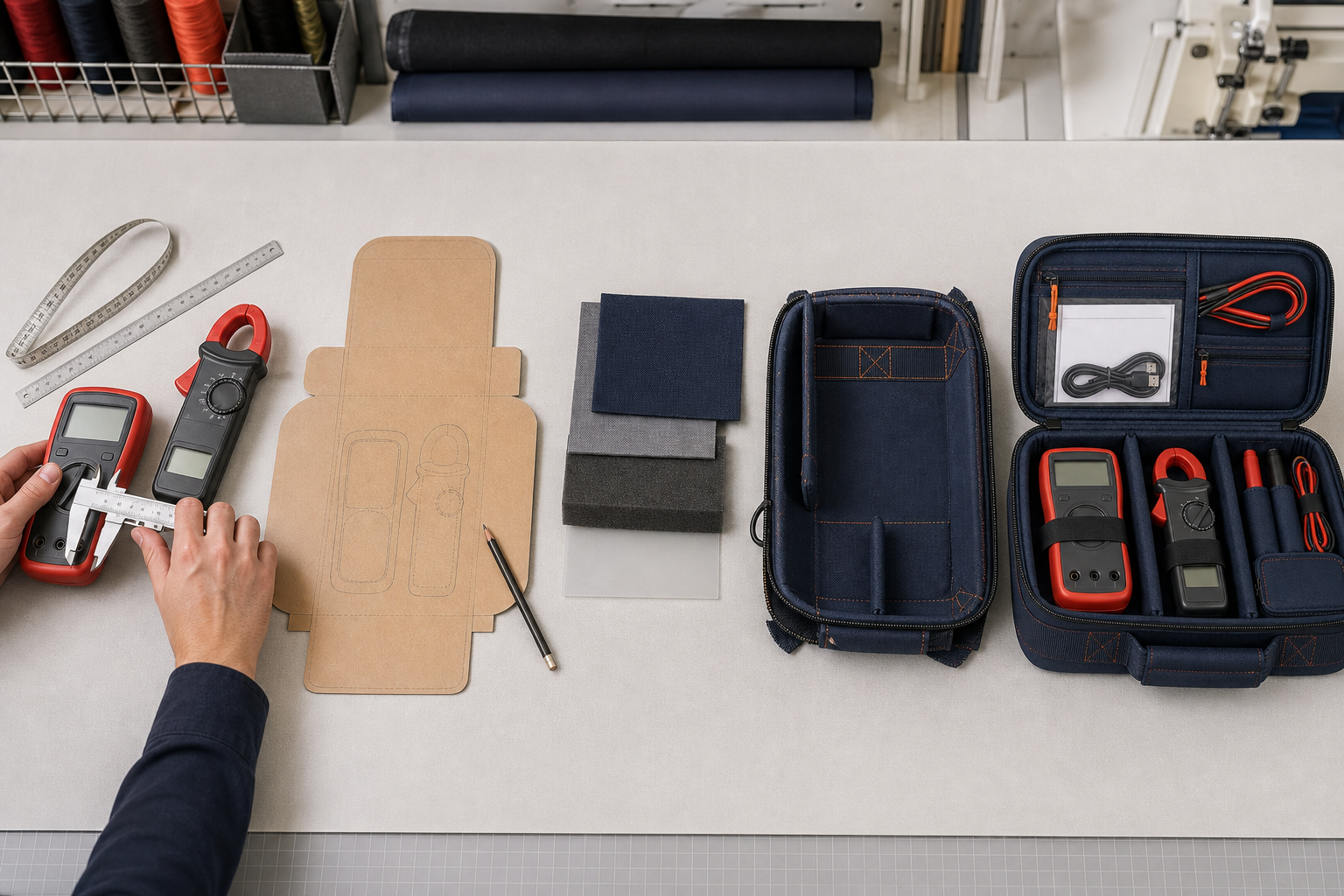 CONCEPT DEVELOPMENT EXAMPLE
Information to send
Photos and rough dimensions are enough for an initial review. Final fit approval may still require an equipment sample when tolerances or access points are critical.
Overall dimensions, weight, fragile areas, connectors and controls.
Probes, cables, chargers, adapters, manuals and consumables that travel with it.
Car, aircraft, service van, indoor plant, construction site or distributor demo.
Hand carry, shoulder strap, trolley attachment or hands-free operation.
First order, annual volume, target launch date, branding and packaging.
Measurement checklist
Lay out everything that must travel in the case and photograph the complete kit before deciding the internal arrangement.
Construction decisions
Abrasion, water exposure, cleaning and desired appearance
Coated polyester/Oxford fabric is a common starting point.Equipment value, impact risk and acceptable case weight
Foam type and thickness should be confirmed on the approved sample.Soft, semi-rigid or divider-supported
PP board, PE sheet or removable dividers may add shape.Fast field access versus maximum protection
Use pockets, elastic loops, dividers or separate removable pouches.Load, opening frequency and field environment
Specify zipper path, buckles, hooks and shoulder hardware.These are RFQ starting points—not fixed performance claims. Materials and construction must be confirmed against the application and approved sample.
Sample approval
A prototype should be evaluated as a working system. Photograph any requested change and identify the exact pocket, seam or dimension affected.
01The complete equipment kit fits without forced loading.
02Fragile surfaces and connectors do not contact loose accessories.
03Handles and shoulder points feel balanced at the real loaded weight.
04The zipper opens without scraping the equipment or trapping cables.
05All pockets, windows, labels and operating openings are in the correct position.
06Finished dimensions, materials, colours and packaging are recorded for bulk production.
Avoid rework
The supplier cannot see knobs, cables, probes or the intended loading sequence.
A case that looks balanced when empty may fail when the full kit is carried.
Terms such as “Oxford fabric” do not define coating, weight, colour or performance.
The approved pattern, component list and packing method should be recorded for consistency.
Copy this structure
Product: [model and product link]
Main device: [L × W × H and weight]
Accessories: [list or kit photo]
Use environment: [where and how it is carried]
Protection: [padding, structure and fragile areas]
Branding: [logo, colour and labels]
Quantity: [first order and estimated annual volume]
Target date: [sample and launch timing]
Request an initial review
We can review whether the project fits sewn soft-case construction and identify the information still needed before sampling.